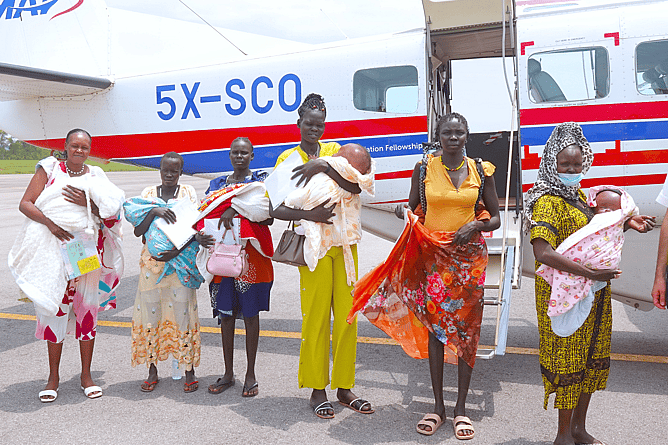
Six babies have a new lease on life, thanks to MAF’s life-changing flight from Juba, South Sudan to Tororo, Uganda, where they could receive surgeries.
Seven-month-old baby boy Nanok Lochok Lojale belongs to the Toposa tribe in South Sudan, a semi-nomadic community that raises cattle according to their traditions.
The youngest of mother Marie’s four children, Nanok, was born healthy, but his head began to swell when he was one month old. Doctors diagnosed hydrocephalus, a condition that leads to swelling of the head. Nanok was among six babies flown to eastern Uganda by the Christian charity organisation, MAF, to receive surgery at CURE Children’s Hospital of Uganda, in Mbale district.
“I just want my baby to be well,” Marie said.
Phoebe Masongole, handling communications for CURE Children Hospital, expressed the team’s gratitude.
“May God bless you abundantly for being Christ’s hands and feet,” she said. “We are deeply grateful to MAF for making this journey possible.”
CARE aims to provide life-changing surgery and Christ-centred care to children worldwide who are living with treatable disabilities.
Usratuna, another NGO in South Sudan, screens the children and refers them to CURE Children’s Hospital, before MAF flies them to Uganda for surgery.
This collaboration between MAF, CURE and Usratuna is supporting children whose parents can’t afford such sophisticated treatment.
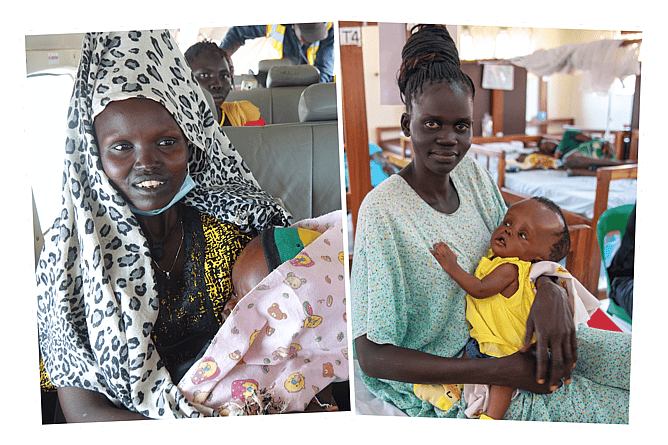
MAF pilot Ryan Unger flew the six children together with their carers.
“What a privilege and joy to be part of the healing journey for these infants,” he said. “Partnerships that transform lives are what we are here for, and it’s always a gift to be able to work with CURE in restoring the health of these children.”
Gabriel, the mother of Gatthep Bar Nyoyok, first noticed a swelling on her baby’s head when he was two months old.
“At first, I thought it was just a minor issue,” said Gabriel. “But as the swelling increased, I became very worried.”
Gatthep is among the babies who can now receive free surgery because of this partnership.
A MAF aeroplane takes only six hours to make the same trip. These flights are a big relief to the already-hurting little one and their parents.
Hydrocephalus is a life-threatening condition if left untreated. It can damage the brain and even impair vision. While there’s currently no cure, the disease can be treated, especially if diagnosed early.
Due to a lack of antenatal care, many parents only discover abnormalities in their babies after birth.
This situation could be quite different if the mothers attended antenatal visits, because hydrocephalus can be detected during pregnancy screening, and doctors say that early detection increases chances of survival. But most of these families are too poor to attend these visits.
STORY & PHOTOS / DAMALIE HIRWA