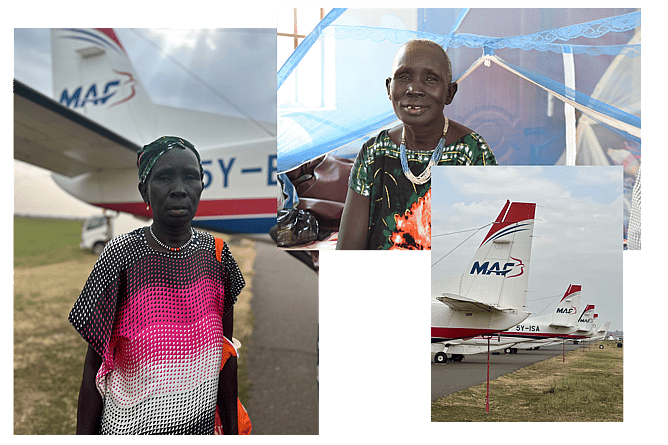
For all her adult life, Ayor has lived with an injury she rarely speaks about. A flight with MAF gave her the chance of life-changing surgery.
The recovery after surgery is slow and painful, and I am aware of this as I walk over to Ayor’s bed in the hospital in Juba. My translator, Garang, asks if she is willing to share her story. Ayor replies with a quiet yes.
Her white hair tells me she is long past the age when women bear children, but her eyes tell a story few other people have heard.
“The fistula followed the birth of my fourth child, over forty years ago,” Ayor says.
“I have been suffering from this condition ever since. My last baby died, and I could not conceive again after that. One of my other children has also died.”
Ayor comes from a village near Yirol in South Sudan. Like many other women in her country, she gave birth without the assistance of a midwife or doctor, and on this occasion it resulted in a serious injury called obstetric fistula.
The injury creates a hole between the birth canal and the bladder or rectum, causing uncontrollable leakage of urine or faeces.
More than physical suffering
For women like Ayor, such an injury brings more than physical suffering – it also brings shame, isolation and stigma. Women do not talk about these kinds of issues in this culture – instead, they hide their struggles and pain. I am struck by Ayor’s quiet dignity and her willingness to share.
“I had surgery before. I was taken to Lokichoggio, but the surgery was not successful, and I did not get well again,” she says.
Despite the disappointment of the previous failed surgery, Ayor decided to try again after a relative in her village told her about fistula surgeries being offered in Juba.
“I went to Yirol, and a MAF plane picked me up. I felt sick on the plane, and I was very happy to land in Juba,” Ayor admits with a smile.
Care for body and soul
At Reconciliation Hospital in Juba, the Evangelical Lutheran Mission offers fistula repair surgery three times a year. Training rooms are transformed into hospital wards to host more than forty women who travel there from across the country.
Most of these women are flown to the hospital by MAF, and recently there were ten such flights. For many of them, like Ayor, undertaking the journey by car or on foot would take days and be virtually impossible.
Specialist surgeon Dr. Andrew is able to repair even the most complicated fistulas – including cases where previous surgeries have failed. Mission chaplains and support staff are also on hand to provide counselling and spiritual care to women who have often suffered rejection because of their condition.
Ayor is grateful for all the care she has received.
“I was operated on, and afterwards the doctors came every morning to check on me. I am happy to receive the help from the people here. I have been going for prayers. They share things with us that make us happy.”
Going home with dignity
Ayor looks forward to being home and well after decades of hardship.
“I am happy to stay in Juba for the surgery, but I will be even happier to go home again to the village! I am looking forward to being healed of this problem. They have made my life better now.”
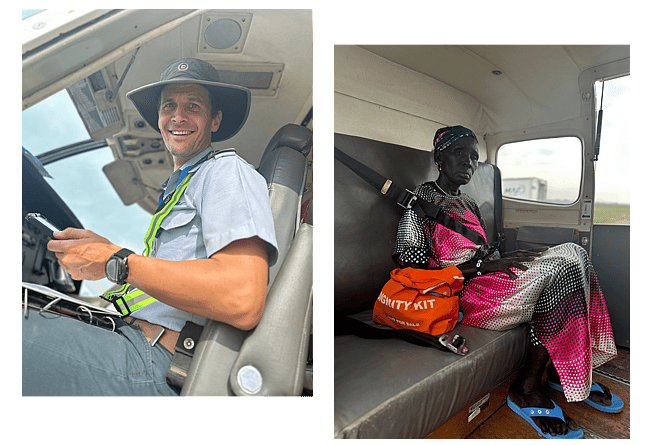
A week later, slowly and with determination, Ayor boards the MAF plane bound for Yirol. Still healing, and probably still in pain, she carefully ascends the aircraft steps.
Then, with the dignity of an “abuba” (grandmother), she settles into “business class” – the seat with extra legroom at the back of the plane.
She is quiet.
And ready to go home.
STORY & PHOTOS / JENNY DAVIES
This story was originally published in "Flying for Life - Autumn 2026." To view the full issue, click here.